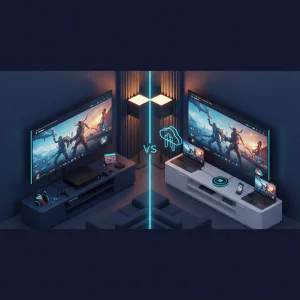
A 64GB DDR5 RAM kit now costs more than a PlayStation 5. Let that sink in for a second. The memory crisis driven by AI demand has thrown gaming hardware pricing into total chaos, and gamers everywhere are asking the same uncomfortable question: do I really need to own this expensive box anymore?
Streaming platforms like NVIDIA GeForce NOW and Xbox’s game streaming service have quietly evolved from laggy experiments into genuinely competitive alternatives. We’re talking RTX 5080-level performance streamed to your phone, your old laptop, even your TV — no console required.
But here’s the thing. “No console required” doesn’t automatically mean consoles are dead. The reality in 2026 is far more nuanced than the clickbait headlines suggest, and the right choice depends heavily on how you actually play games.
This guide breaks down cloud gaming performance against native hardware across every metric that matters: latency, visual fidelity, cost over time, game library access, and the hardware trends shaping what comes next. Whether you’re budget-conscious, a competitive player, or simply curious, you’ll walk away knowing exactly where your money goes furthest.
Fair warning — some of what you’ll read might surprise you. The gap between streamed and local gameplay has shrunk dramatically, but it hasn’t disappeared entirely.
What Is Cloud Gaming and How Does It Actually Work in 2026?
Cloud gaming streams video games from powerful remote servers directly to your screen. Instead of your device running the game locally, a data center handles all the heavy lifting — rendering graphics, processing physics, managing AI — and sends the video feed to you in real time. Your controller inputs travel back to the server, and the cycle repeats dozens of times per second.
Think of it like Netflix, but interactive. The critical difference? Latency matters enormously. A half-second delay watching a movie is invisible. That same delay in a first-person shooter gets you eliminated before you even see the enemy.
In early 2026, the technology has reached a turning point. NVIDIA’s GeForce NOW Ultimate tier runs on RTX 5080-class servers with DLSS 4 support, streaming at up to 4K 120fps — or even 5K resolution for members with the bandwidth to support it. Xbox Cloud Gaming has expanded to Samsung, Hisense, and Vizio smart TVs, turning any screen with a controller into a gaming device.
The latency numbers tell the real story. On a solid fiber connection, GeForce NOW delivers click-to-pixel response times around 11-12 milliseconds. For context, native gaming on local hardware sits around 16ms. That gap? Barely noticeable for most people outside competitive esports.
Xbox’s cloud infrastructure runs on custom Series X hardware in Microsoft’s data centers. The streaming quality caps at 1440p currently, with 720p and 1080p options for slower connections. It’s a console-quality experience by design — reliable, consistent, but not pushing the bleeding edge the way GeForce NOW does.
One newer feature worth mentioning: Xbox’s “Stream Your Own Game” library added 88 titles across January and February 2026 alone, letting subscribers play games they already own via the cloud. GeForce NOW counters with over 4,500 supported games through its Install-to-Play expansion, though you need to own titles on Steam, Epic, or other storefronts.
Cloud Gaming Performance vs. Console and PC: The Real Numbers
Let’s cut through the marketing and look at actual performance comparisons — because this is where the conversation gets interesting.
Visual Quality and Frame Rates
GeForce NOW’s RTX 5080 tier tested with Cyberpunk 2077 at 4K delivered frame rates consistently above 100fps with max settings and ray tracing enabled. On Steam Deck OLED via the cloud, modern AAA titles hit 90fps at the handheld’s native refresh rate. Those are numbers that would cost well over $1,500 in local hardware to match.
Native console performance on PlayStation 5 and Xbox Series X typically targets 60fps at upscaled 4K, with some titles offering 120fps performance modes at lower resolutions. The visual gap has narrowed significantly, though local rendering still produces cleaner image quality pixel-for-pixel — no compression artifacts, no occasional frame pacing hiccups from network jitter.
Latency and Input Response
This remains the Achilles’ heel of game streaming, though it’s healing fast. GeForce NOW with NVIDIA Reflex technology measured roughly 13ms ping on testing servers, with total click-to-photon latency approaching local hardware levels on fiber connections. Xbox Cloud Gaming performs well on stable broadband, but competitive shooters still feel slightly less responsive than playing locally.
Here’s the honest assessment. Casual gaming, RPGs, strategy titles, story-driven adventures? Cloud latency is essentially invisible. Competitive multiplayer at higher ranks? You’ll probably notice the difference, and serious players will want local hardware for that last few milliseconds of advantage.
| Metric | GeForce NOW Ultimate | Xbox Cloud Gaming | PS5 / Xbox Series X (Native) | Gaming PC (RTX 5080) |
|---|---|---|---|---|
| Max Resolution | 5K / 120fps | 1440p / 60fps | 4K / 60fps (upscaled) | 4K / 120fps+ |
| Typical Latency | 11-13ms | 25-40ms | 8-16ms | 8-16ms |
| Ray Tracing | Yes (DLSS 4) | Limited | Yes | Yes (Full) |
| Internet Required | Yes (50+ Mbps) | Yes (20+ Mbps) | No (offline capable) | No (offline capable) |
| Monthly Cost | $19.99/mo | $19.99/mo (Ultimate) | $0 (after console purchase) | $0 (after PC build) |
The Cost Equation: Xbox Game Pass vs. PS5 vs. Building a Gaming PC
Money talks. And right now, it’s screaming at anyone trying to buy gaming hardware.
The RAM crisis fueled by AI data center demand has pushed DDR5 memory prices up dramatically since early 2025. A 64GB DDR5-6000 kit that cost around $200 in mid-2024 was selling for over $500 by late 2025. GPU prices followed, with NVIDIA reportedly cutting production by 40% for the first half of 2026. PC manufacturers like Dell, Lenovo, and HP have announced price increases ranging from 15-20%.
Consoles haven’t escaped either. Industry analysts expect PlayStation 5, Xbox Series X|S, and the Nintendo Switch 2 to see price bumps of 10-15% as memory costs eat into manufacturing margins. Sony and Microsoft reportedly face memory accounting for over 35% of console production costs.
Against that backdrop, the subscription streaming model looks increasingly attractive. Xbox Game Pass Ultimate at $19.99 per month gives you access to hundreds of games plus cloud streaming — no hardware purchase beyond a controller and whatever screen you already own. GeForce NOW Ultimate at the same price point delivers RTX 5080-class performance to any compatible device.
Run the math over three years. Game Pass Ultimate totals roughly $720. Add a $60 controller and you’re at $780 for three years of gaming on hardware you already own. A PlayStation 5 at current pricing plus a dozen games at $70 each runs close to $1,340. Building a capable gaming PC? You’re looking at $1,200 minimum in today’s inflated market — and that’s before buying a single game.
The catch — and there’s always a catch — is ownership. Cancel your subscription and your entire library vanishes. That PS5 sitting on your shelf still plays your disc collection a decade from now. Your downloaded Steam library persists whether you’re subscribed to anything or not. For some people, ownership matters enormously. For others, access is enough.
Gaming Hardware Trends Reshaping 2026 and Beyond
Something fundamental is shifting in how the gaming industry thinks about hardware. And it’s not subtle anymore.
Microsoft is leaning hard into a hybrid future. The Xbox app now runs on smart TVs from Samsung, Hisense, and Vizio. A refreshed cloud gaming web interface launched in January 2026. Rumors of a new hybrid Xbox console — bridging traditional home hardware with handheld portability and tighter cloud integration — keep gaining momentum. The company clearly sees a world where the “Xbox” isn’t a box at all.
NVIDIA’s approach differs but points in the same direction. GeForce NOW expanded to Linux PCs, Amazon Fire TV sticks, and even flight simulation peripherals at CES 2026. The Install-to-Play feature nearly doubled the available cloud library overnight. NVIDIA isn’t selling hardware to consumers anymore — it’s selling access to hardware that lives in data centers.
Meanwhile, Valve’s Steam Machine — a living room PC running SteamOS — was delayed from Q1 to the first half of 2026 specifically because of the RAM crisis. The irony here is thick. The hardware designed to compete with consoles got stalled by the same market conditions pushing people toward cloud alternatives.
PlayStation remains the most traditional player. Sony’s strength lies in exclusive titles optimized specifically for PS5 hardware — DualSense haptics, fast SSD integration, developer-tuned performance that cloud streaming simply cannot replicate. Early whispers about PlayStation 6 targeting a late 2027 release suggest Sony still believes in dedicated hardware, though even they’ve been expanding PS5 Remote Play capabilities.
The broader trend? Gaming ecosystems matter more than individual boxes now. Your game progress, your friends list, your subscription — those travel across devices. The hardware becomes interchangeable. Whether that makes consoles “obsolete” is really a question of semantics. They’re evolving, not dying.
Who Should Choose Cloud Gaming (And Who Shouldn’t)
Not everyone’s situation is the same, so let’s be specific about who benefits most from each approach.
Cloud gaming makes strong sense if you:
- Have reliable broadband at 50 Mbps or faster with low latency to nearby data centers
- Play primarily single-player games, RPGs, strategy titles, or casual multiplayer
- Don’t want to invest $500+ on dedicated hardware right now
- Value portability — playing on your phone, tablet, laptop, or TV interchangeably
- Already own a Game Pass subscription and want to maximize its value
- Live in a well-served metro area with strong internet infrastructure
Native hardware still wins if you:
- Compete seriously in fast-paced multiplayer games where every millisecond counts
- Live in a rural area or have unreliable internet with data caps
- Want to own your games permanently without subscription dependency
- Care deeply about maximum visual quality without any compression artifacts
- Play VR titles, which require local processing power
- Enjoy offline gaming during travel or internet outages
Honestly? The smartest play for most people in 2026 is a hybrid approach. Use cloud gaming as your primary platform, and keep affordable local hardware — maybe a last-gen console or budget PC — for situations where streaming falls short. That’s not a cop-out answer. It’s what the industry itself is building toward.
5 Tips to Get the Best Cloud Gaming Experience Right Now
- Prioritize wired Ethernet over Wi-Fi. Even a fast wireless connection introduces variability that cloud gaming amplifies. A simple Ethernet cable can transform a stuttery stream into a smooth experience overnight.
- Check your proximity to data centers. GeForce NOW and Xbox both maintain server lists. If you’re within a few hundred miles of a data center, latency drops substantially. Rural players farther away may want to temper expectations.
- Test before committing. GeForce NOW offers a free tier with limited session times. Xbox Cloud Gaming is included with any Game Pass Ultimate trial. Spend a weekend testing before making financial decisions.
- Invest in a quality controller. The Xbox Wireless Controller remains the gold standard for cloud gaming compatibility across platforms. Budget around $50-60 for a reliable input device — it’s the one piece of hardware that genuinely matters.
- Monitor your data usage. Cloud gaming at high quality burns through 10-15 GB per hour. If your ISP enforces data caps, do the math before marathon sessions. Unlimited broadband plans are essentially a prerequisite for serious cloud gamers.
The Verdict: Are Consoles Becoming Obsolete in 2026?
Short answer? No. Longer answer? It’s complicated, and the timeline matters.
Consoles aren’t disappearing this year or next year. Hundreds of millions of PlayStation and Xbox units sit in living rooms worldwide, supported by massive game libraries and deeply loyal communities. Nintendo just launched the Switch 2. Sony is reportedly developing PlayStation 6 for 2027. These companies aren’t abandoning dedicated hardware.
What’s happening instead is a gradual shift in how gaming is accessed. Cloud streaming is becoming a complementary layer — not a replacement — for local hardware. Microsoft explicitly designs for this with Game Pass spanning console, PC, and cloud. NVIDIA positions GeForce NOW as an extension of your existing PC library, not a walled garden. Even Sony’s Remote Play pushes PlayStation experiences beyond the living room.
The hardware price crisis accelerates this transition. When building a capable gaming PC costs more than ever and even console prices creep upward, a $20 monthly subscription that delivers high-end performance to screens you already own becomes genuinely compelling. For budget-conscious gamers, students, and families testing the waters, cloud gaming may already be the better financial choice.
But for competitive players, enthusiasts who demand absolute visual fidelity, anyone in areas with spotty internet, or people who fundamentally value owning their games — local hardware isn’t going anywhere. The future isn’t one or the other. It’s both, working together, with the balance gradually shifting toward the cloud over the next five to ten years.
Frequently Asked Questions
Is cloud gaming good enough to replace a PS5 or Xbox Series X in 2026?
For casual and mid-core gamers with reliable broadband, streaming through GeForce NOW or Xbox delivers a comparable experience for most game genres. You’ll notice differences in fast-paced competitive titles where input latency matters, but for story-driven games, RPGs, and cooperative multiplayer, the gap has narrowed enough that many players find cloud streaming perfectly adequate as their primary gaming platform.
How fast does my internet need to be for cloud gaming?
Most streaming services recommend a minimum of 15-20 Mbps for stable 1080p. For 4K quality on GeForce NOW Ultimate, you’ll want at least 50 Mbps, with NVIDIA recommending wired Ethernet connections for the best results. More important than raw speed is connection stability — low jitter and consistent ping matter more than headline bandwidth numbers.
What’s cheaper long-term: Game Pass Ultimate or buying a console?
Over a typical five-year console lifecycle, Game Pass Ultimate costs roughly $1,200 in subscription fees. A console at current prices plus a modest game library runs $1,000-$1,500. The financial comparison gets closer than most people expect, but Game Pass includes hundreds of games in the subscription while console owners typically buy games individually. Your spending habits determine which wins for your budget.
Will the gaming hardware price crisis end soon?
Industry analysts don’t expect memory prices to stabilize until at least late 2026, with some forecasts stretching into 2027. The shortage is driven primarily by AI data center demand consuming global DRAM and NAND supply, and major memory manufacturers haven’t signaled significant production increases. PC vendors have announced 15-20% price hikes, and console manufacturers face similar cost pressures from rising component prices.
Can I play competitive multiplayer games on cloud gaming platforms?
You can, but with caveats. GeForce NOW with NVIDIA Reflex delivers latency around 11-13ms on optimal connections, which is acceptable for most competitive play below professional tiers. Xbox’s streaming adds slightly more latency. If you’re competing at high ranks in games like Valorant, Apex Legends, or fighting games where frame-perfect inputs matter, local hardware still provides a measurable advantage.
Does GeForce NOW include games, or do I need to buy them separately?
GeForce NOW does not include games with the subscription. You need to own titles on supported platforms like Steam, Epic Games Store, Ubisoft Connect, EA App, GOG, or Xbox (with PC Game Pass). The service provides the cloud hardware to run your existing library — think of it as renting a powerful remote PC rather than a game subscription service. Xbox Game Pass Ultimate, by contrast, bundles both a game library and cloud streaming access.
What happens to my games if a cloud gaming service shuts down?
This is one of game streaming’s biggest risks. Google Stadia’s shutdown in 2023 demonstrated what happens when a service closes — players lost access to their streamed games, though Google refunded purchases. With GeForce NOW, you retain ownership of games on Steam or other storefronts regardless of NVIDIA’s service status. Xbox Game Pass games, however, are only accessible while your subscription remains active and the title stays in the rotating library.